
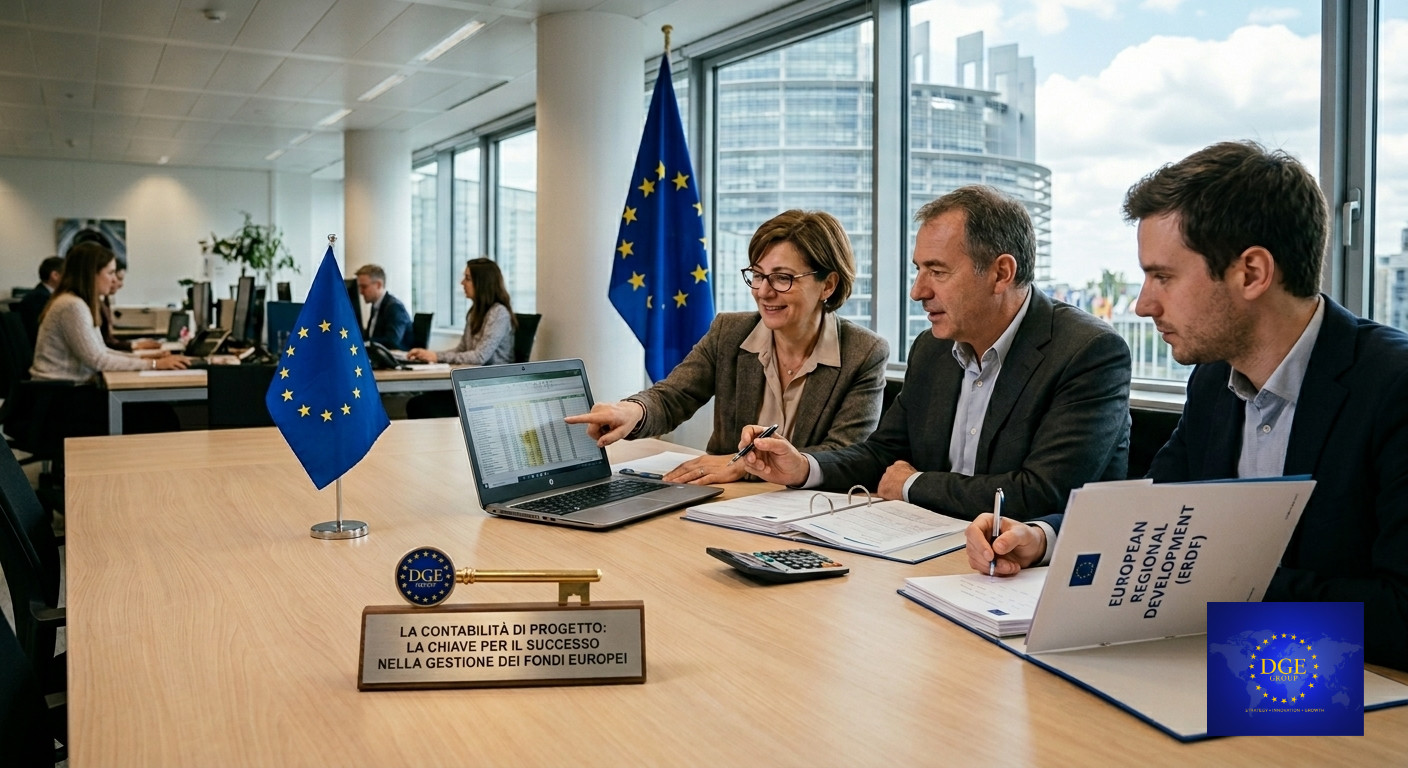
Project Accounting: Growing Demand for European Calls for Proposals
European Project Management: Separate and Transparent Financial Reporting for Funded Projects
Access to European funds has become a strategic lever for many businesses, training institutions, associations, and public administrations. Programmes such as Horizon Europe, LIFE, Erasmus+, ERDF, NRRP, and many others offer substantial funding opportunities. However, those who secure a European grant soon discover that the greatest challenge is not winning the call, but correctly reporting the expenses.
The growing demand for project accounting is the direct consequence of this reality. Funded projects require separate, transparent, traceable financial reporting that complies with strict eligibility rules. An accounting error can be costly: ranging from the obligation to refund the contribution to exclusion from future funding.
In this article, we explore why project accounting has become indispensable for those operating with European calls for tenders, what the main challenges are, and how DGE Group provides tailored solutions for project financing and contracts.
What is project accounting?
Project accounting is a management approach that assigns each funded project an independent cost centre, complete with its own chart of accounts, budget, and financial reporting. Unlike general accounting (which tracks all business transactions in an aggregated manner), project accounting allows you to:
📌 Definition: According to EU regulations, separate (or cost) accounting is an explicit requirement for most European calls. Without it, expenses cannot be recognized as eligible.
Why the demand for project accounting is growing
In recent years, several factors have driven the demand for project accounting expertise:
|
Factor |
Description |
|---|---|
|
Increase in European funds |
The 2021-2027 EU budget and Next Generation EU (NRRP) have made unprecedented resources available |
|
Stricter controls |
The European Commission and managing authorities have intensified audits, reducing tolerance for errors |
|
Complexity of eligibility rules |
Direct costs, indirect costs, lump sums, simplified cost options: reporting methods are increasingly complex |
|
Professionalisation of the sector |
A general accountant is no longer enough: dedicated project accounting specialists are required |
|
Digitalisation |
Information systems require advanced traceability and integration with European portals (e.g. Funding & Tenders) |
📊 Key figure: According to a survey by Europa Creations, the demand for consultants specialising in project accounting has grown by 35% over the past three years, with a peak linked to NRRP tenders.
The challenges of financial reporting for European projects
Reporting on an EU-funded project is a complex process with numerous pitfalls. Here are the most frequent ones.
1. Ineligible costs
Not all expenses can be reported. For example:
2. Incorrect allocation of direct and indirect costs
Direct costs (dedicated personnel, travel, consumables) must be kept separate from indirect costs (rent, utilities, administration). Many companies misclassify these expenses, leading to financial adjustments during audits.
3. Documentary traceability issues
Every expense must be supported by audit trail documentation: invoices, contracts, staff timesheets, and proof of payment. Missing even a single document can result in the rejection of the entire cost.
4. Personnel management
Hours dedicated to the project must be documented using daily or monthly timesheets signed by the manager. During an audit, missing or generic timesheets are one of the primary causes of findings.
5. Foreign exchange rates
For projects involving foreign partners (outside the EU), expenses in a different currency must be converted correctly, often using the ECB exchange rates for the month in which the expense was incurred.
6. Consistency with the approved budget
Reported expenses must align with the categories and ceilings set out in the approved budget. Unauthorized variances are not eligible.
Project accounting for project financing and contracts
In addition to European project design, project accounting is also required in other contexts:
Project financing
In project financing initiatives (e.g., concessions, public-private partnerships), project accounting is essential to:
Contracts and job orders (works, supplies, services)
For businesses working on a contract basis (e.g., construction sites, industrial supplies, complex consulting), project accounting allows you to:
💡 Best practice: adopting a project accounting system integrated with general accounting reduces errors and facilitates audits.
How DGE Group supports project accounting
At DGE Group, we offer tailored project accounting solutions for businesses, institutions, and professionals operating with European funds, project financing, and contract work.
Our services
|
Service |
Description |
|---|---|
|
Project accounting setup |
Creation of cost centers, analytical chart of accounts, integration with general accounting |
|
Financial reporting management |
Document collection and verification, calculation of eligible costs, preparation of reports for the funding body |
|
Support for periodic reporting |
Interim reports, final reports, reimbursement claims |
|
Audit assistance |
Preparation of documentation, support for the project manager during inspections |
|
Staff training |
Tailored courses for project teams and administrative departments |
|
Accounting for project financing |
Cost/revenue monitoring, reporting to lenders and investors |
|
Accounting for contract work |
Management of work-in-progress reports, margin calculations, client reporting |
Our approach
Conclusions and key takeaways
The growing demand for project accounting reflects an unequivocal reality: to successfully access and manage European funds (and funded projects more broadly), traditional general accounting is no longer enough. It requires specialized expertise, traceable systems, and a proactive approach to financial reporting.
Key points to remember
How can we help you? Discover DGE Group services
At DGE Group (www.dgegroup.eu), we support businesses, institutions, and professionals in the administrative and financial management of funded projects. We offer:
👉 Contact us today for an initial free consultation. Discover how we can help you report your funded projects with confidence and transparency.
Find out if your business is eligible for grants and subsidized financing
Every year, millions of euros in public funds remain unallocated because companies do not know how to apply for them. We help you seize these opportunities.
Free assessment of active opportunities – We analyze open calls and grants tailored to your industry and region
Personalized checklist – Receive the full list of required documents and eligibility criteria to meet
Clear timelines – We provide you with a schedule outlining deadlines and milestones for submitting your application
Grant maximization – We identify potential bonus criteria (partnerships, Southern Italy, etc.) to increase your funding amount
“We have already assisted dozens of businesses in securing funding for innovation, export, and the energy transition. Yours could be next.”